Walking Tour

Wednesday, November 12, 2014

Week 7


Week 7 Journal:  The Last Saturday Field Trip 


Location: Whidbey Island - Ebey's Landing.  Deception Pass, Skagit River Delta


This last Environment 280 Saturday field trip was special to me because we were visiting places that I have been before, which is something that hasn't happened yet on our class field trips.  The trip was all about the birds, but also a little about the natural history of course!
At Ebey's landing we were able to see a very historic area.  One of my favorite parts of this day was learning the history of the family, the land, and most of all their interactions with native indians.  Now unfortunately for me, the two women who live on this land, didn't explain in lecture format, like I would have liked because it was so interesting to me.
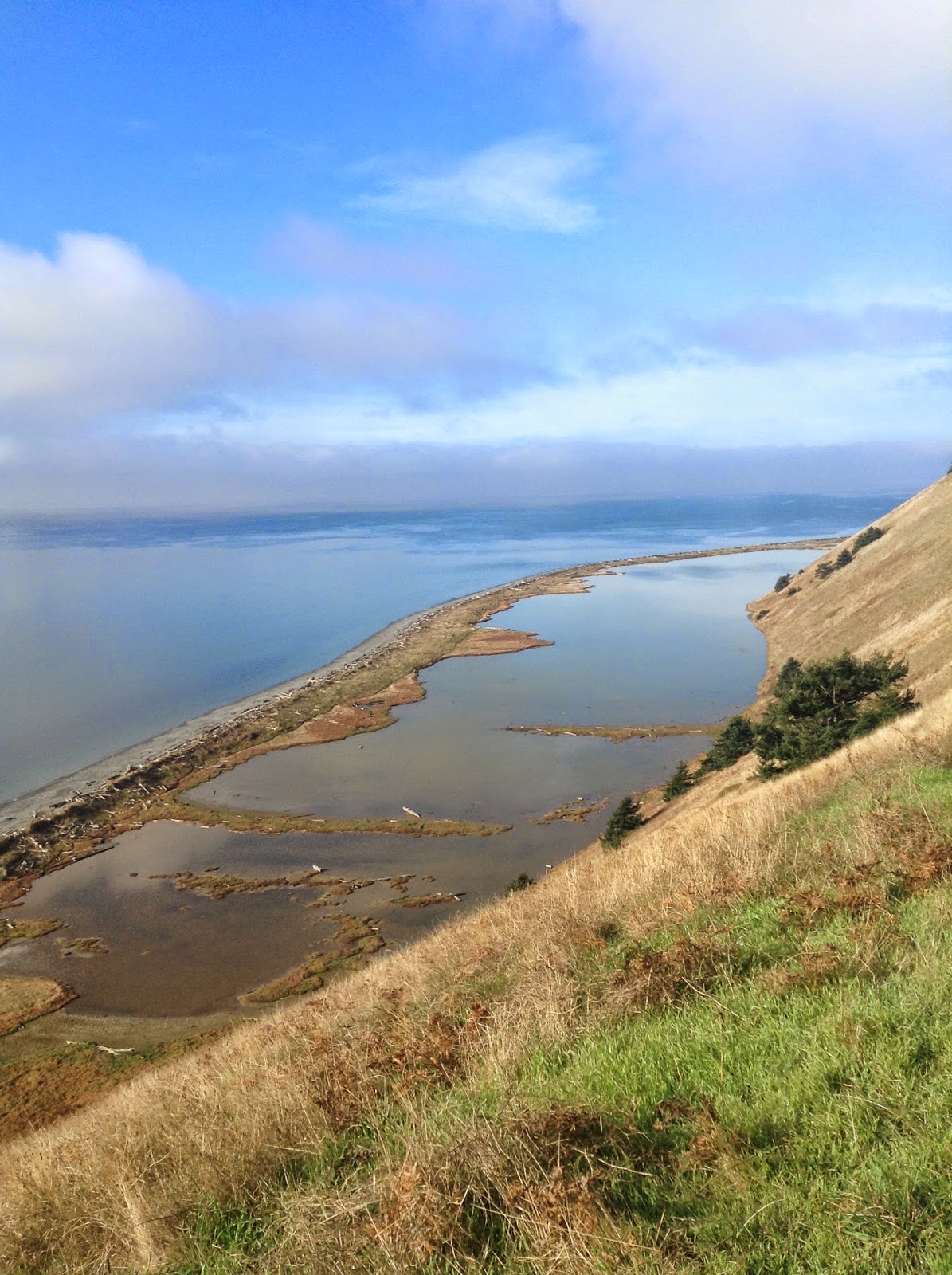
We had an hour to two hours to hike, observe, and explore this area and to the left and right are photos of how I spent
my time on this part of the island.  The lagoon to the left was amazing and unexpected and to the right shows my brother Sam and I taking the steep walk from the end of the path to the beach below.

Species from the entire day:
Glaucous Winged Gull
Golden Crown Sparrow
Song sparrow
Bald Eagles
Red-Tailed Hawk
Marsh Wren
Sitka Spruce
Fungi/Lichen
Cackling Geese
King Fisher
Northern Carrier
Shorebirds
Killdeer
Golden-Eye Ducks

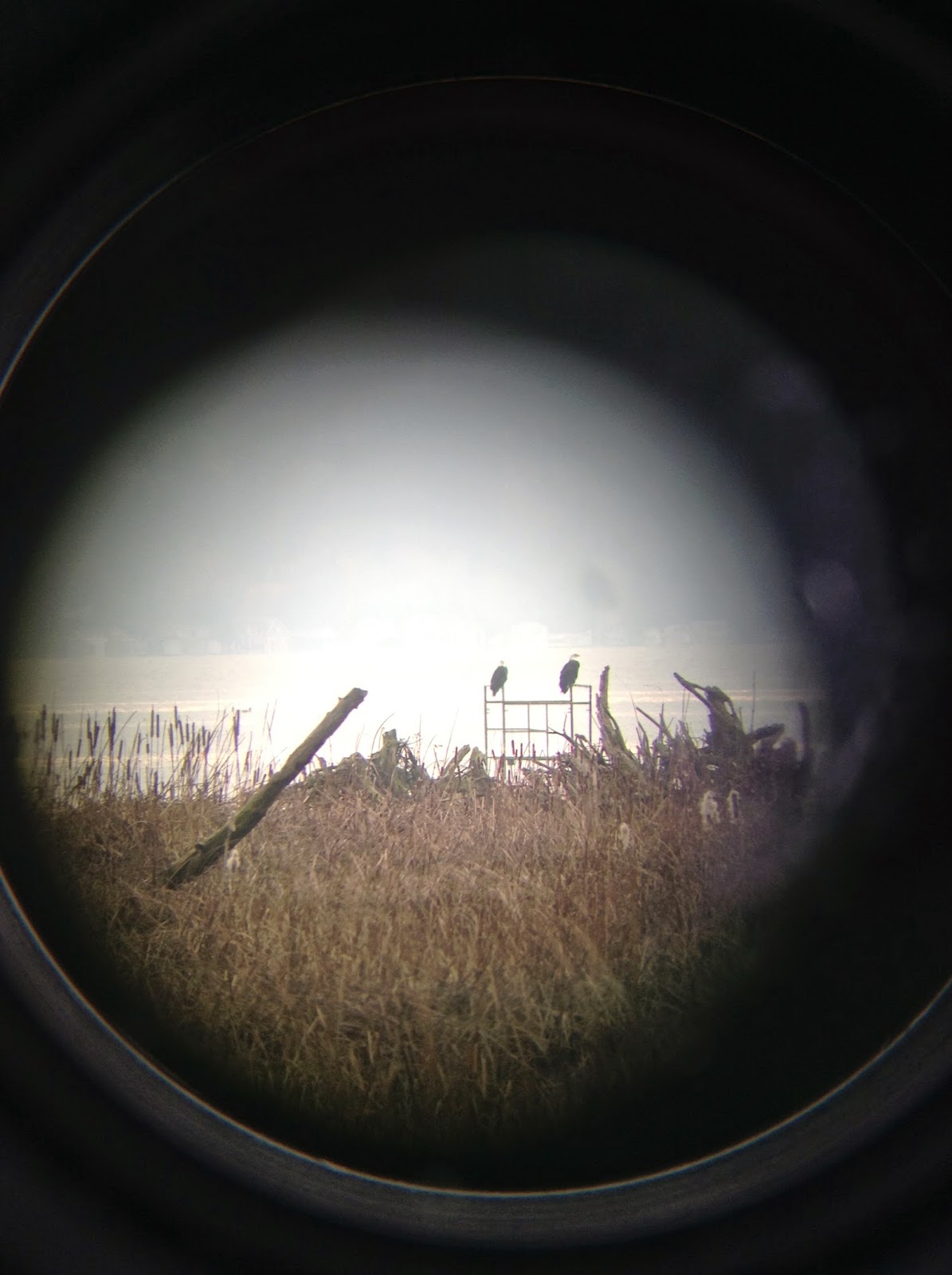
The bird catching near the parking lot at Ebey's landing was a very unique experience.  Looking back at my time in nature, it's very rare, if it ever even happened, to remember seeing birds this up close.  Seeing Jorge and Tim do something that is so in their element was inspiring and then to see the outcome, or the pictures to the left/right/below, was pretty rewarding for all who saw.  The other picture below is with my camera through the scope set up, trained on two bald eagles.  So regal and relaxed that it made me wish all of nature was like this.  Either that or I just wish there were way more bald eagles.
One of the places we stopped after Ebey's were bird watching stops along the Skagit River Delta.  It was one of the more interesting bird stops because, while there may not have been as many species as there were around Ebey's, there were some very different sights to observe.  We were all pretty stumped by the shorebird-type-birds that were flying in a huge pack a half mile away.  They stuck together very well and I personally could not see any birds with just my eyes, but when I got some binoculars or the scope up to my eyes, I was surprised I hadn't been able to see anything at all!

Cassie Maylor


Thursday, November 6, 2014

Week 6


 Week 6: 

Decompressing in Nature: A post-midterm blog


Day after a very windy and rainy night, around 12:30pm in the afternoon, currently raining, and temperature in the low 50s. 


Noticing Phenological Changes: Every week I see more and more leaves and needles on the ground.  This is the most obvious of all the changes at my nature spot because it is the fall season, and we have been getting lots of harsher weather recently.  However, I have noticed that there are many, many more needles on the ground and I assume that is due to the weather.  Many of the ground plants, for instance this ivy-like one on the fallen tree- have been slowly disappearing.
This directly above (left) is what the tree used to look like (week 1) compared to the directly above, right hand picture in week 6.

The pictures below illustrate close up, and from a distance the phenological changes I mentioned above, with the increased number of needles and leaves covering the ground, leaves, and tree branches.  


PLANT:  It shoots up out of the earth as if someone asked it to be there right then.  You can't quite see the life inside of this organism but you can sense that it has its own specific timeline, separate from the rest of surrounding life, yet somehow through where it comes through the earth with a purpose and a job.

BIRD:   A strange noise comes from somewhere within the trees around me.  It is almost impossible to understand where, why and how this noise has flew through the trees for me to hear.  These moments when this noise graces my ears is amazing because it confirms for me that life is up there somewhere and not just the trees itself.
CREEK:  I can hear it, I can feel it, I can smell it, I could taste it, I can feel it, confirming to me that it is there and it is alive in some form.  Nothing is to say whether or not this constantly moving thing has more purpose than it shows on it's surface. For it flows and runs with purpose and desire like a living thing.  It's purpose is not clearly evident and one has to study what happens on top, within, and on the bottom of this part of nature to figure its life goals.


http://www.inaturalist.org/observations/cmmaylor
Cassie Maylor

Wednesday, October 29, 2014

Week 5

Journal for Week 5:

Mycology in Ravenna Park : In Class and For the Nature Blog


http://www.inaturalist.org/observations/cmmaylor


 Above are some of the pictures I managed to not accidentally delete from my camera this week while in Ravenna Park.  Below are the sketches I made of the rest of the fungi species I observed while in my Nature spot in Ravenna. 

Unidentified Fungi: The orange one above was found further from the creek, growing in the soil around some of the smaller bushes.

Mycena: A fungi species that is very common in Ravenna Park.  It grows on the ground and whenever I've seen it, it's always been in pretty wet areas.  In my nature spot they grow near the trees that are near the creek.  

Unidentified Fungi:  This fat, flowery looking mushroom was found growing in the soil.  It was very distinctly gilled on the underside, and was damp from the rain on top, but had a slick texture.  It was a pretty sturdy head of the mushroom and a less so sturdy stem. 

Turkey Tail:  Found growing on a broken off branch of a tree aka grows specifically on wood.  This fungi is pretty tough and hard.  When I went to pick one of the heads of the mushroom off the wood, it took some effort to complete.  The bottom is very white around the edges, has rings along the top of the mushroom, and seems to be not too young of a mushroom. Different coloring in the middle compared to the edge of the bottom. 

White (unidentified) Mushroom: This flowery looking mushroom was found growing in the soil, and was surrounded by moss and fallen leaves as you can see above.

Lichen:  Found growing on a douglas fir in my natural area.  Possibly Rag Lichen. Identified on iNat.

Cassie Maylor


Sunday, October 19, 2014

Week 4

Week 4: Noticing the Biotic and Abiotic Changes


The day's details: Sun out all day, mid 60s F, shaded in my area with a little sunlight coming through from the west, yet the ground was slightly damp, no wind.

Before I identify 5 invertebrates at my nature site, I wanted to document some of the new species I am seeing and able to identify on my own through what I have learned through field work in class.

Species I have been able to identify on my own:
(Pictured below)

Sword Fern
Western Red Cedar
Salmon Berry
Holly Bush
Beaked Hazelnut
Pacific Yew and
Douglas Fir


I looked back at my albums for my previous weeks of observation of this area and there are a lot more leaves on the ground.  When I first found my area there was a definite trace on the forest floor that it was most definitely fall.  Compared to now, where I have to physically move leaves from the ground to see what is growing, or living beneath.
The only new species arrivals that I have seen so far this week were probably the teeny tiny ones I was neglecting, that I will go into more detail about below, and the new bird that flew into my line of sight as I entered my nature area.
Below are fuzzy pictures of this particular Chestnut-Backed Chickadee. (located in the middle of both)


The five invertebrates sketched in pictures (with noted details) below are a few centipedes, two different spiders, one Daddy-long Leg-Arachnid class, a Banana Slug-Gastropod class, and a Common Pillbug-Crustacean class. 
The centipedes sketched, and in a photo below, are unclassified right now on my iNaturalist site because I am not positive, if they are of the centipede class or a larvae that I can not distinguish yet. 

The invertebrate above seemed so small that it might not be a centipede, but perhaps a larvae of some kind.  They were existing on a leaf that was resting upright against the wood of an old fallen tree stump.  They did not move for the entirety that I sat there sketching them and observing them. 
The spider above moved so quickly across the leaf on which I found it, I hardly had time to take a picture of it.  In the end I gave up and just tried to be still and watch it skitter across the small bush's leaves.  Luckily for me, it ended up looking a lot like daddy-long leg picture n Audubon's field guide.  I also have lots of these spiders in my garage at home so I am used to this particular spider.  When it was scurrying away from me, it couldn't have really run directly away, he went more down under the leaves to escape me. 
The banana slug above was about 12 paces away from my central point near the creek, so I infer that this slug isn't too fond of the wet.  It was also in a pretty dry area, which is impressive because my area is typically pretty damp since I am near the creek and under a lot of trees.
Last but not least is the pill bug I found when got on my stomach to look closer at the forest floor.  I lowered myself down so that I could take a look at what was under the tree stump.  There I found the pill bug, studied it, and then did a memory sketch because I had to stand up.  I then reached back under the stump and picked out this pill bug, mostly because I always did that as a kid, and it curled up into its instinctive ball, where I sketched it again.  Then I set the little guy in a place that I could easily see it and sketch it while it was out on its legs exploring the tree log I put him on.

Cassie Maylor


Saturday, October 11, 2014

Week 3

Journaling from locations around the Puget Sound Region


Day 1: Nisqually River Delta, Mima Mounds, Gravel Location


NISQUALLY RIVER DELTA

     This first destination was my favorite for day one because of the biodiversity in the area.  The Nisqually River Delta is one of the most biodiverse areas in Washington State.  Being at the river delta made me very nostalgic because I was being reminded of what I learned when I was in elementary school geography and eighth grade Washington State history.

The exciting moment for everyone on this day was the tornado sighting.  It must have been less than a mile away because I could see without binoculars the water and/or dust that the wind was picking up around the eye of the tornado. 


MIMA MOUNDS
     The Mima Mounds was a place I had never heard about until day one of the field trip.  It was really intriguing to see something that I had never witnessed and have to convince myself that they weren't man made.


List of Species Day 1:

Tree frog, Bull frog, Great Blue Heron, Red Alder, Western Hemlock, Northern garder snake, Snail, Caterpillar, Hawk, Bald Eagle, Black Cottonwood, Red Alder, Mallard Duck, Snowberries, Banana Slug, Cedar Waxwings, Osprey, Gulls, Shorebirds, Cinnamon Teals, Marsh Wren, Pin-tailed Ducks, Widgeon

Four Plant Species Day One:  The top two pictured are from the Nisqually River Delta, and the bottom two are from our Mima Mounds destination.  In the case of this snowberry bush in the upper left, I observed that it was growing in close proximity to other bushes. Since they all seemed to be a little crowded together the branches of the snowberry, and the shrubs/bushes around it, were intertwined, and seemed to be growing together.  The bottom left picture is of an Early Blue Violet.  This species stood out to me at the Mima Mounds because it was one of the few species I could see with vibrant color.  They also did not grow in bulk, or whenever I saw one it was usually growing by itself along the path.  The leaves in the top right corner have not been identified yet, but here is a link to my iNaturalist page where I recorded my observations: 
http://www.inaturalist.org/observations/cmmaylor.  The picture in the bottom right corner is Coastal Reindeer Lichen.  This lichen was really interesting to me because of how it was growing because it was the plant closest to the ground and could grow across large areas despite all the grasses that grew around it.  In the case of both of these species from Mima Mounds, you can tell they have adapted to climate and their geography.  The Blue Violets were all windswept and blown over looking.  While the Reindeer Lichen I'm sure might grow on trees, but in this destination it is forced to adapt to grow just along with the grasses.  

Above in this sketch of my view from top of the trail looking out at the Nisqually River Delta, you can see the snags that are still standing at pretty close distances to where I was standing.  My favorite part about this landscape sketch, and why I decided to draw it, was the dimension that can be seen from the grasses closest to me, to the trees and water in the middle, to the mountain line and clouds in the distance.  

Day 2: Mount Rainier Old Growth Forest Stop, Paradise, Panorama Point

MT RAINIER AND OLD GROWTH FOREST
     The first stop on day two of this weekend's field trip was my favorite for the day.  It was a very biodiverse and unique old growth forest.  There were many varieties of fungus and mushrooms all around the trees, nursery logs, and ground floor of the forest.

Four Plant Species Day Two:  At the old growth forest there were many opportunities to grab a shot of a mushroom and fungi.  I snapped the two pictures below of a mushroom growing out of the side of a fallen tree.  The one below is most likely in the Bracket family and quite possibly the artist's fungus.  I read that this fungus grows in places where movement is not required, so for this fungus's life it will hang on to this tree for as long as it can.  Below the fungus pictures is a picture of some lettuce lichen which is common in this area and is referred to sometimes as the forest's litter.  I think that this family of lichen has adapted to its ground floor habitat by having the texturized surface.  This particular lichen was very moist, per the day's conditions.  The tree species pictured below are (top) a young Mountain Hemlock and a Subapline Fur (far-away, and close up).  These trees are similar to me, and both species to me seem to have adapted to a cold-weather climate.


Above is a rough landscape sketch done on the bridge on the way to Mount Rainier.  In the middle you see the glacial run off as well as the pretty prominent tree line left over from the Puget lobe of the last ice age.   


Above is the sketch I made from a picture I took when the class trekked out on to an unmaintained trail so that we could observe where the glacier had been and what it is now.  I have labeled what I was attempting to sketch on the paper.  Some of those features include where the differentiation of where the snow and where the rock is.  Unfortunately in this picture/drawing you cannot see the water that is running down the glacier, but I have included a picture above that I took of the scope where you can closely see how the water is flowing.  
This was probably the most important view of the weekend and it has a very crucial natural history story for the Pacific Northwest.  The remainders of the ice masses that engulfed the mountain sides of Mount Rainier are the left overs of the glaciation period five hundred thousand years ago.  But, more importantly to our view and perception of Mount Rainier, is from the more recent little ice age, that has occurred during the last ten thousand years, when glacial advances renew.  


iNaturalist: http://www.inaturalist.org/observations/cmmaylor

Cassie Maylor